Category Archives: Uncategorized

March with Macy

Image

March with Macy

I have been part of the young people of color cohort of The Work that Reconnects. We’re reading from the book Coming Back to Life: Practices to Reconnect Our Lives, Our World and being mentored by the author, Joanna Macy. We have a lot of discussions. Not just talking, but embodiment of the ideas. Patricia St. Onge brings in her expertise with the deep culture work and together all 19 of us hum with gratitude, pain, new eyes, and agency. “We live in an extraordinary moment on Earth.  We possess more technical prowess and knowledge  than our ancestors could have dreamt of… at the same time we witness destruction of life in dimensions that confronted no previous generation in recorded history” Macy says.

On Avocados and Assassination

Standard

Today is an important day for me politically. Eleven years ago, on February 15, 2003 I led my first public anti-war march. It was the day that the world said No! to war. Twelve million people were in the streets that day. Last year on this day, I was sitting in a house with sunshine coming in the south-facing window and an avocado tree in the backyard, thinking about all that has transpired in the last decade. Among other things, I was inspired to begin this blog.  This continues to be a space where I articulate what is at my core; a container that holds what swirls in my stomach as I sit in the belly of the beauty-beast.

This Feb 15 anniversary rivals in importance other days of the year that I hold dear: New Years Days (all of them: Gregorian, Rosh Hashanah, Nayruz, Ras-as-Sanah al-Hijriyah, Chinese), birthdays, Easter, and Kwanzaa.  Side note on Kwanzaa: I like Kwanzaa in a universal (non-nationalist) sense, and for the way in which it is a family holiday in which you can construct “family” in whatever arrangement of people you want.

On February 15, 2003 I found my voice in the public square at People’s Park, declaring “Not in Our Name!” will any war wage.  Because I was wearing a t-shirt from the Martin Luther King Center for Nonviolent Social Change, the COO at that time came up to me afterwards, told me she was impressed, and asked me to call her. I did. That was the beginning of my relationship with the King Center and it continues today. Just last month I assisted behind the scenes with the January King Holiday Observance, and crafted the current 100 days of nonviolence. It was a fun, demanding, and instructive time.

So today, when a wonderful activist who I admire asked me to participate in a reader’s theater about the pressing environmental and social issues of our time, I checked my calendar.  Though my calendar is basically scheduled solid through August, I found I am available for one of the practices and the performance date. I am moved by the effort, Project Unspeakable. It is a collective that has cropped up around the issues related to the assassinations of John F Kennedy, MLK, Bobby Kennedy, and Malcolm X.  It is a time to consider again the nagging questions about the assassinations of these four leaders, and to be reminded again of their inspiring visions.

Through the use of grassroots live theater, this political project is going viral and reaching diverse audiences.  It is providing a lens through which, playwright Court Dorsey says, helps us to “better understand what is happening in this country today.”  The project, he writes

has the potential to bolster current demands for governmental and corporate openness, transparency, and democratic accountability—a likely prerequisite for effectively addressing the multiple social, political, and environmental crises we face.

I know that many people enjoy killing and are okay to be killed violently. But there are many who don’t want to be. And I work with and on behalf of the many who do not want to be in that cycle. We are building deep alternatives mud-brick by mud-brick. We are reaching deep to shift our consciousness and letting that permeate the space around us. We are in the streets, suites, and soup kitchens; explaining, protestifying, serving, and sometimes shouting in resistance to the unharmonious system which destroys ecosystems: the rich are getting richer and the poor are getting poor and we’re quickly becoming out of reach of one another. The play has also got some great quotes:

James Baldwin: “To act is to be committed, and to be committed is to be in danger. Without the joyful acceptance of this danger, there can never be any safety for anyone, ever, anywhere.”

Audre Lorde: “When we speak, we are afraid.  But when we are silent, we are still afraid. So it is better to speak.”

There is a real difference between contemplative silence and the unspeakable. The former is a clearing of ever expanding space, detachment, and calm. The latter is the suffocation of ever condensing collapsed psychological space, total attachment to what is, and false hope.

Someone else said it once, when you write a book, you should write two. First the book you want to write and then the book you don’t want to write—the book you don’t want to be written by anyone—the book that critiques all of your ideas and asks if the questions you’re asking even matter.  But this is the book that will actually sell. (Who told me this?!) I’ve met so many amazing characters in my recent intentional journey through the wilderness…I feel like Pilgrim in Pilgrim’s Progress from This World to the World That is to Come.

My character in Project Unspeakable is Tenay. Tenay is the bridge person between the audience and the readers in the reader’s theater play.  These are literally the final words in Tenay’s mouth, confirming what I feel has been a reality in my mind since organizing at Spelman in 2003:

(to Narrator 1) “…whatever I’m feeling, it’s better than feeling nothing.”
(to the audience) “I’m glad you’re here.”
(to MLK, JFK, RFK, MX) “I’m old enough to die a good death.”
(to the audience) “May we all have the courage to live a good life.”

Play Ends

Well, I didn’t ask to be reminded of the precariousness of my life-in-the-public today. I was just going through bills (the first bills I’ve ever had in my name…electric and gas, what a puzzle to decipher what all the charges are for exactly). I was sitting here in front of the heater after having done some fabulously strenuous exercise and semi-disorienting grocery shopping. I just arrived back to Chicago yesterday on V-Day (2nd year of Strike! Dance! Rise! to end violence against women!) and spent most of my time so far re-familiarizing myself with my home. It’s the first home I’ve lived in alone, though I am in a building with a lot of cool people. We all speak Spanish.  I’ve only been here 13 days since I left for my “40 day wilderness experience” before getting oriented for CPT Executive Director leadership. I’m age 30 and each CPT term is 3 years, so that’s 30-33 and those are my Jesus years, and one shouldn’t play with those years! I have a lot of energy to give to the cause and glory of God via CPT, and I want to be strategic, healthy, grounded, and loving for this term.  They do say, if you work for the church, “make sure you look good on wood…” Anyway, I don’t know what will happen at the end of these 3 years of ministry (notice “ministry” is the root word of administration) but I believe in the hope of the resurrection.

I am not saying I’m someone’s or some organization’s messiah. I am not thinking about these issues of leadership and assassination from an elevated sense of self-importance. The s/hero mentality is not all that helpful or inclusive. It takes all of us to make this revolutionary world go ‘round. But if I live my life fully and perform my calling it appears I will be asked to be in bridging places, places of leadership, articulation, responsibility, and a target.

Many call me exceptional. But I am not. I am not so savvy, nice, or protected that I will be spared the difficulties many leaders have faced. I may very well be eliminated by the system. Many people are eliminated every day. We don’t know their names but at times I can feel their presence, their encouragement to “pay attention.” If the system can get us to do it to ourselves, the easier it is for them. If they can get us to push out other movement leaders, even better for them.  That is why part of my nonviolence commitment is to never fatally eliminate my conversation partner…to always remember that there is no one I cannot learn something from.  On the other hand, I am exceptional because I was raised by a group of people who have a high anthropology, demand to live the fullness of life in discipleship of God Incarnate, and are willing to speak the unspeakable.

I wonder who the actual assassin will be to off me, though it will likely be part of a much larger plan. Which one of my close associates may fold? Which one of the people I’ve (unintentionally) pissed off? Which member of my community is on the margins/in opposition enough to be used psychologically to tear me down?  Which guy I’m just getting to know will turn on me when I don’t fulfill his wishes? Which car as I walk home down the pedestrian-less street? Which member of a street-organization will shoot me as a matter of a routine task for higher-ups? (And then Chicago will capitalize on the incident to legislate for more money for the cops to fight gangs). Or will it just be an arranged car accident?

It may occur here, it may occur on one of my travels. I think of CPT delegate Tom Fox. He was kidnapped in Baghdad with three others; later he was separated from them. They were released, he was assassinated. Tom was clear going in about the dangers that he faced there. I will quote from a book about him and the emotions of people worldwide at the time of this hostage crisis that reflects on the organization I have been called to lead:

Christian Peacemaker Teams take their identity seriously. Their namesake, after all, was another unarmed troublemaker in an occupied country, who was tortured and then suffered an ignominious public execution. One other phrase that comes to mind is Matthew 10:24, ‘The disciple is not above their master, nor the servant above their Lord.’ Did Tom and others have illusions? Not in CPT. It was a CPT team, after all, that brought the first reports about the abuses at Abu Gharib prison to reporter Seymour Hersh. They had also seen other humanitarian workers kidnapped and some killed.”

The L goes by up above the houses across the street. Every time I hear it I stop to take a deep breath, or at least relax my shoulders and teeth, which are often a bit tense due to all the typing, texting, or even just how I hold my body. What is so bad about not breathing anymore? I ask myself. Death by bullet or crash will probably be quick. Poison will take longer.  X was poisoned in Egypt at one point. I guess all of these experiences will involve new sensations that I have not felt yet. I am open to everything.  People will mourn and vigil, and hopefully new inspirations and partnerships will be birthed in the sad wake.  Eventually though, as editor Chuck Fager reflects in the book about Tom, even though they will feel a bit guilty, people will move on.  Much of this interplay of life and death is about money in the end, and any focus on me will only refract back how many thousands more people are being kidnapped, “held, tortured, and some killed, by factions from all sides, amid a bloody confusion of agendas.” As long as I am alive today doing work that I believe in, together with others who seek to guide our life-forces toward compassionate understanding that re-members our original state of wellness, I am happy. Each day is full of newness and potential.

“Keep yo’ dome up,” a frienemy of mine often says.

What if I do not get assassinated? Well, I am happy to grow up and over one hill after another.  I certainly do not want to die of a preventable health condition early. I do not want to live with migraines, kidney problems, anxiety, sugar-processing issues, hormonal imbalances or menstrual problems. I am so glad that feminist author-activist Eve Ensler defeated the cancer in her womb.  That is really great.  I know other leaders who suffer health problems accelerated by their work in the Movement.  And how can we not be touched by that which we care most deeply? Especially when making an impact demands that all cylinders are firing for at times hours/days/weeks/months on end? The practice of Sabbath is important, I’ve got that structured in. But there is also something mentally that demands regular recalibration, something related to attachment, suffering, and integrated healing…shout out to all the acupuncturists out there who help keep the circulation going strong.

Even Obama is afraid to be assassinated.  Project Unspeakable noted his recent response to a progressive reporter who asked him about why he isn’t making some of the changes he said he would. He replied, “don’t you remember what happened to Martin Luther King?” So, the President may be afraid of the CIA. He’s got two daughters and he doesn’t want to get killed.

Maybe kids will make me selfish, and make me want to stay alive in a way that will make me less courageous.  Or, maybe “my” children will be a gift to the world to continue the legacy of radical discipleship and service once I’m gone.  Children are not a guarantee of anything. I was just talking with some of my good friends in LA about children over a surprise V-Day dinner.  Community is key.

Community is a great antidote to thinking too much about these things. I wish to think about them neither too little nor too much.  Writing it down documents my thinking, and as my fave feminist professor used to say, “you write to learn what you know.” The Israel/Palestine issue is propelling closer and closer to the surface each day.  As they say colloquially, “the shit is about to hit the fan.”  One of my colleagues in her work with JVP has already felt the threats (a WANTED poster, people in vans or cars sitting outside her house, the crazy-making stress of false friends, etc.).

And it’s so much easier to watch people these days. Everything is on the internet, and is accessible to the NSA. Good thing I have nothing to hide.  There are certainly some embarrassing stories out there that could blow back in my face.  OAuth and the ever increasing miles-deep pile of data available are kinda creepy and frustrating.  And we’re all so longing for fame, community, convenience and acknowledgement that we’re willingly putting it out there.

Many times I find it exhilarating to be a bridge person. I live for connecting people and communities together, especially across lines of difference.  I know the drawbacks are that you get walked on, or as the case in Mostar, you can get bombed.  But riseup.net noted this about bridge people:

Even in really large campaigns, there are often only a handful of people who are the connectors.  Without them communication, coalition, coordination, and solidarity will break down.  With the NSA spying program, they can easily see who the bridge people are, and who they need to target. Sound paranoid? Or are we at a point where nothing sounds paranoid anymore?

So, one real question is, how do I organize and use my time well if I want to make the most impact and I know that I have limited time?  How do I live my life with a knowing that I may not live a long life? One answer is one word: Fully and consistently. I seek to be consistent…ethics and beliefs in alignment.

And, given the way that I live my life, it is not likely that assassination will be what takes me out. I mean, I do other activities that are kind of precarious. I do feel like I take my life in my own hands when I get out on these US streets to bicycle.  And driving and riding in cars can be a major liability too. So, I always wear my helmet, and my seatbelt, and just hope to be lucky.  I have been lucky so far.

Also, in death, people can be made martyrs and put on a pedestal.  While that is attractive to the ego that wants to be an inspiration even beyond one’s lifetime, it can also be harmful to the cause.  In the end it is not about who killed the four men featured in Project Unspeakable, but about why they were killed.  Because, as they play says, “if you answer the why, you will understand the same things are still happening.  Until we address that, we’re all in trouble.

I can understand that life in this part of reality is hard. Some can’t or just don’t want to face the consequences (pleasant or demoralizing).  The play notes this dynamic:

Better to hand over the job of thinking and doing and setting moral standards to those who are surely “in the know.” Better not to feel too much until the crisis ends—and if it never ends, at least we’ll have suffered a little less, developed a useful dullness, protected ourselves as much as we could with a little indifference, a little repression, a little deliberate blindness, and a large dose of self-anesthetics.

I used to not believe that this was true. I used to think everyone was living their lives waiting for someone to come and cut through the layers of myth with the searing truth, and personally invite them into the revolution.  Then I’d thought they’d drop everything and joyfully and diligently orient their lives—through meaningful work—around the practices of transformation. I got this belief pounded out of me in Jerusalem (and by traveling throughout Israel proper and in occupied Palestine). It took a lot of emotional pounding to dislodge it, but I was finally able to accept that what many people truly want is an easy life. There I also saw the impact of having different sets of facts, internalized the fungibility of truth, and was nourished by the labyrinthical layers of Abrahamic religious stories.

President John F. Kennedy said, “the great enemy of the truth is very often not the lie—deliberate, contrived and dishonest—but the myth—persistent, persuasive, and unrealistic.

One reason I’d be bummed to be assassinated is that I likely would no longer be able to eat ripe avocados and mangoes anymore. They are really delicious!

And so are you. Thanks for reading all the way to the end. My life is better because you are in it.

Sarah

P.S.  As Joanna Macy said last weekend at the People of Color cohort for the Work that Reconnects, we are alive at this moment because of the intelligence of the universe, the accident of my life, the movements for holistic social change, and the well wishes of many surrounding us. Let us give gratitude, honor our pain, see with new eyes, and go forth.

No Winter Whining!

Standard

Even though I live in the polar vortex of Chicago, I have committed to #nowinterwhining. I was almost about the succumb to the context chatter that many have all around me about how “bad” the weather is. I realize that snow and ice are water in another form. I am made of 70% water. Snow and ice is me in a different form. chicago polar vortex 1This gives me the opportunity to examine the different forms I am in at different seasons of my life. How does what is happening outside remind me of the changes I am going through? I was pondering this as I got out from the lightening-quick shower that I took at Planet Fitness (because the hot water heater was broken on January 2).  I knew it was broken before I jumped in there, but I wanted to clear myself of any tendency to whine about the winter weather once and for all.  It worked.

During this time of winter I have also gone through an interesting process of moving in to “my own place.” Yes, my own little place in the polar vortex. It’s quite something, this process of moving in.

Moving in in the winter is also somethun intense! The snow was piling high outside today and I didn’t leave my house at all! That hardly ever happens (neither me having a house nor staying in one place ALL day long) But, I got nearly all moved in and arranged!

One’s attitude an experience changes a lot if you commit to not whining about it, but get some good boots (or whatever equipment you need for the job) and keep your dome up and face the music.

More later… In the meantime #nowinterwhining.

 rules-polar-vortex-weather-closures

Appointment as Christian Peacemaker Teams Executive Director / Nombrada la directora ejecutiva de Equipos Cristianos de Acción por la Paz

Standard

CPT INTERNATIONAL: Sarah Thompson appointed CPT Executive Director
17 December 2013

Christian Peacemaker Teams is pleased to announce the appointment of Sarah Thompson to the position of CPT Executive Director, starting in January 2014.  

Thompson brings a wide range of experiences to the position. Through her work in the international peace movement as a public-speaker and community organizer, she is adept at bringing people together across lines of difference and building momentum for positive social change. Her Christian church involvements include six years of volunteer work as the North American representative to Mennonite World Conference’s Youth and Young Adult Executive Committee and Global Youth Summit planning group, as well as service with Mennonite Central Committee in Jerusalem, Washington, D.C. Advocacy office, and in her hometown of Elkhart, Indiana, United States.

Thompson has traveled across various continents through activist and volunteer work with feminist anti-war movements, Spanish translation opportunities, the Fulbright Scholarship, and Spelman College (graduated summa cum laude in 2006 with a Comparative Women’s Studies & International Studies double major, and a minor in Spanish).

A 2011 Masters of Divinity graduate of Anabaptist Mennonite Biblical Seminary, Thompson writes, “I am thrilled and humbled to participate with CPT in this capacity. I feel called to the spiritual practice of building partnerships that transform violence and oppression. I am grateful to all who have gone before me to make this organization a place where I can use my gifts, bring my questions, encounter challenges, and rely on support from allies and colleagues.”

Thompson recalls, “I first learned about CPT’s edgy peacemaking programs and analysis of structural oppression when I was in Peace Club at Bethany Christian High School in Goshen, Indiana (1999-2002). After attending the CPT Peacemaker Congress my sophomore year, I knew that CPT would be a part of my future.  I was thinking more along the lines of when I retired, but was delighted to have been invited to participate sooner.”

Outgoing Director Carol Rose says, “This is going to be great! We are beginning a really exciting period in CPT’s history.  I am confident to hand over leadership to Sarah who is creative, capable, and caring. Her activism grounded in deep faith, coupled with her brilliant thinking, brings a dynamism that will help keep CPT moving with joy and partnering powerfully.”

Thompson served as a member of CPT’s Steering Committee (2010-2012) and has worked for the past year as CPT’s Outreach Coordinator. “I am very grateful for these opportunities,” she says. “Like my previous work with grassroots, political, and social-justice organization, working through CPT has been a deeply formative and positive experience for me.” The focus of the Executive Director role will be on strategic directions for organizational development, undoing oppressions, and fund- and friend-raising.

—To introduce yourself to Sarah, and/or to schedule her for a speaking engagement or fundraising event for CPT, please contact her at director@cpt.org. In light of this good news, please share this announcement widely, and click here to make a gift in support of Sarah as she begins as Executive Director.

ECAP INTERNATIONAL: Sarah Thompson nombrada la Directora Ejecutiva de ECAP
17 diciembre 2013

Equipos Cristianos de Acción por la Paz (ECAP) se complace en anunciar el nombramiento de Sarah Thompson para el cargo de Directora Ejecutiva de la ECAP, a partir de enero de 2014.

Thompson aporta una amplia gama de experiencias para el puesto. A través de su trabajo en el movimiento por la paz internacional como organizadora de la comunidad y predicadora, ella es experta en invitar a la gente conectarse; cruzando las barreras y diferencias y trabajando junta para el cambio positivo social. Sus cargas dentro de la iglesia cristiana incluyen seis años de trabajo voluntario como la representante de América del Norte para el Comité Ejecutivo de Jovenes Adulto del Congreso Mundial Menonita y el grupo de planificación de la Cumbre Mundial de la Juventud. También como una voluntario con el Comité Central Menonita en Jerusalén, la oficina de Asesoramiento en Washington, D.C., y en su ciudad natal de Elkhart, Indiana, Estados Unidos.

Thompson ha viajado por varios continentes a través del activismo y el trabajo voluntario con los movimientos pacifistas, feministas, oportunidades de interpretar entre al español y inglés, la Beca Fulbright, y Spelman College (se graduó summa cum laude en 2006 con los dos especializaciones: estudios y de las mujeres comparativos, y estudios comparativos internacionales, con una sub-especialización en español).

Graduada en 2011 con una Maestría en Divinidades del Seminario Anabautista Bíblico Menonita, Thompson escribe: “Estoy muy contenta y honrada de participar con ECAP en esta capacidad. Me siento llamada a la práctica espiritual de la creación de alianzas que transforman la violencia y la opresión. Estoy muy agradecida a tod@s los que han ido antes que yo. Han hecho que esta organización sea un lugar donde puedo usar mis dones, traer a mis preguntas, encontrar desafíos, y contar con el apoyo de los aliad@s y colegas. “

Thompson recuerda: “Aprendí de los programas de la no-violencia activa de ECAP y el análisis de la opresión estructural cuando yo estaba en el Club de Paz en Bethany Christian High School en Goshen, Indiana (1998-2002). Después de asistir al Congreso de Acción por la Paz de ECAP mi segundo año del colegio, yo sabía que ECAP sería una parte de mi futuro. Yo estaba pensando más en la línea de cuando me jubilé, pero estoy encantada de haber sido invitada a participar antes y ahora.”

La Directora actual, Carol Rose dice: “¡Esto va a ser genial! Estamos comenzando un período muy emocionante en la historia de ECAP. Estoy segura de entregar el liderazgo a Sarah que es una persona creativa, capaz y simpática. Su activismo con apoyado por una fe profunda, junto con su pensamiento brillante, aporta un dinamismo que le ayudará a mantener ECAP animado con alegría y haciendo lasos de alianza fuertes”

Thompson se desempeñó como miembro del Comité Directivo de la ECAP (2010-2012) y ha trabajado durante el último año como Coordinadora de Promoción de ECAP. “Estoy muy agradecida por estas oportunidades, ” dice ella. “Al igual de mi trabajo previo con comunidades de base, las organizaciones políticas, y la justicia social, el trabajo de ECAP ha sido una experiencia muy formativa y positiva para mí. “El enfoque de la función de Directora Ejecutiva estará en las planes estratégicas para el desarrollo organizacional, deshacer opresiones, y la recaudación de fondos y hacer amig@s para la organización y la causa.

— Para presentarte a Sarah, y / o para invitar a ella por una ponencia o un evento de recaudación de fondos para ECAP, por favor póngase en contacto con ella en director@cpt.org. (Ella entiende y escribe en español). A la luz de esta buena noticia, por favor comparta este anuncio ampliamente, y haga clic aquí para ver la página de web (en inglés) para donar en apoyo de Sarah al comienzo de su trabajo como Directora Ejecutiva.

Thinking about Mandela’s Transformation

Standard

I mean, he used to blow up buses. The point is to get attention and force the powerful to address the injustices.

Those 27 years in Robben Island did something to him.  And the movement continued, changed, deepened, grew. They helped sing him out of prison: https://www.youtube.com/watch?v=XKCk8o5xzaM

He came out and helped to lead a nonviolent transformation (of people, the state, the society). That was the method. The point was still to force the powerful to address the injustices. Rivonia Trial speech: http://www.rfksafilm.org/html/speeches/mandela.php

Some people say that you have to be transformed and all peaceful internally before you do something powerful in the world. But I think Nelson started before he was “all together” internally, and it was the process of healing his world that he healed himself.

Thanks for your amazing life and witness over time. You inspired me and so many others. We’re going to get out there and seek to address the injustices the best and most effective way we can, whether we have it all together or not.

Religious Peacemaking Panel

Standard

Passionately naming and undoing oppressions is one of my favorite and most intense spiritual practices. The movement centered around Jesus–the renewal he envisioned and the revelation he embodied–I believe calls all members to this practice.

For me, the process of examining and addressing interpersonal and structural oppression wherever others or I observe it is the external aspect of the internal acts of confession and repentance.

I define oppression as something that presses in one someone or something else, causing it not to have deep-breathing room, impeding  fullness of life.

Since September 2012 I have been working on these issues through a full-time opportunity with Christian Peacemaker Teams (CPT).  In an article entitled “Embodying Peace, Transforming Violence,” published in The Other Journal, I outline my beliefs and my work with CPT.  Click here if you’d like to read it.

Other thoughts on religious peacemaking:

“Traditions, as Cornel West likes to say, are the like the wind at our back.  We are lucky that previous generations struggled to send that wind our way, and it is our responsibility to provide it to the next generation.  The stories of self-us-now we tell today are simply the next chapter in an overarching narrative of hope, justice, and pluralism.”  -Eboo Patel, Interfaith Youth Core

“If I had to convey a single message to U.S. foreign policy practitioners, it would be that religion matters. For good or for ill, religion is increasingly important in our world.  What’s more, the nature of religion in many places is changing; it is becoming more dynamic, more activist, and more political.  While the majority of religious movements are peaceful, some errant ideologies are at work justifying and encouraging violence.  These ideologies must be countered, and countered effectively.  Military force can never fully protect us from the type of terrorist assaults that have taken place over the past decade. Ideologies must be countered with ideas, and ideologies steeped in religion need to be challenged on religious grounds.” -Douglas M. Johnston, International Center for Religion & Diplomacy

“Tamar’s life could have been different. A princess in David’s kingdom, she would have married into a wealthy family.  But that all change with the only [biblically] recorded event of her life, described in the Hebrew Scriptures 2 Samuel 13:  A family member forced himself on her, then turned her out of his room.  She cried aloud for all to hear, but the one person who did hear, her brother Absalom, counseled her to not take what happened ‘to heart.’  Rarely preached from the pulpit, this is a story that needs to be heard, because what happened to Tamar happens to one in three women and girls today.  They are our mothers, sisters, aunts, daughters, selves–women and girls harmed by violence and silence.  Worldwide, violence against women takes many forms: sexual violence, sexual harrassment, trafficking, ‘honor killings,’ and other forms of murder.  Such violence distorts the image of God that is in all of humanity.  Victimization is never God’s will–fullness of life is.  The church [and all communities of faith] need to help create intentional safe spaces so that healing can begin.”     -Aimee Kang, Sojourner’s Magazine February 2013, page 9.

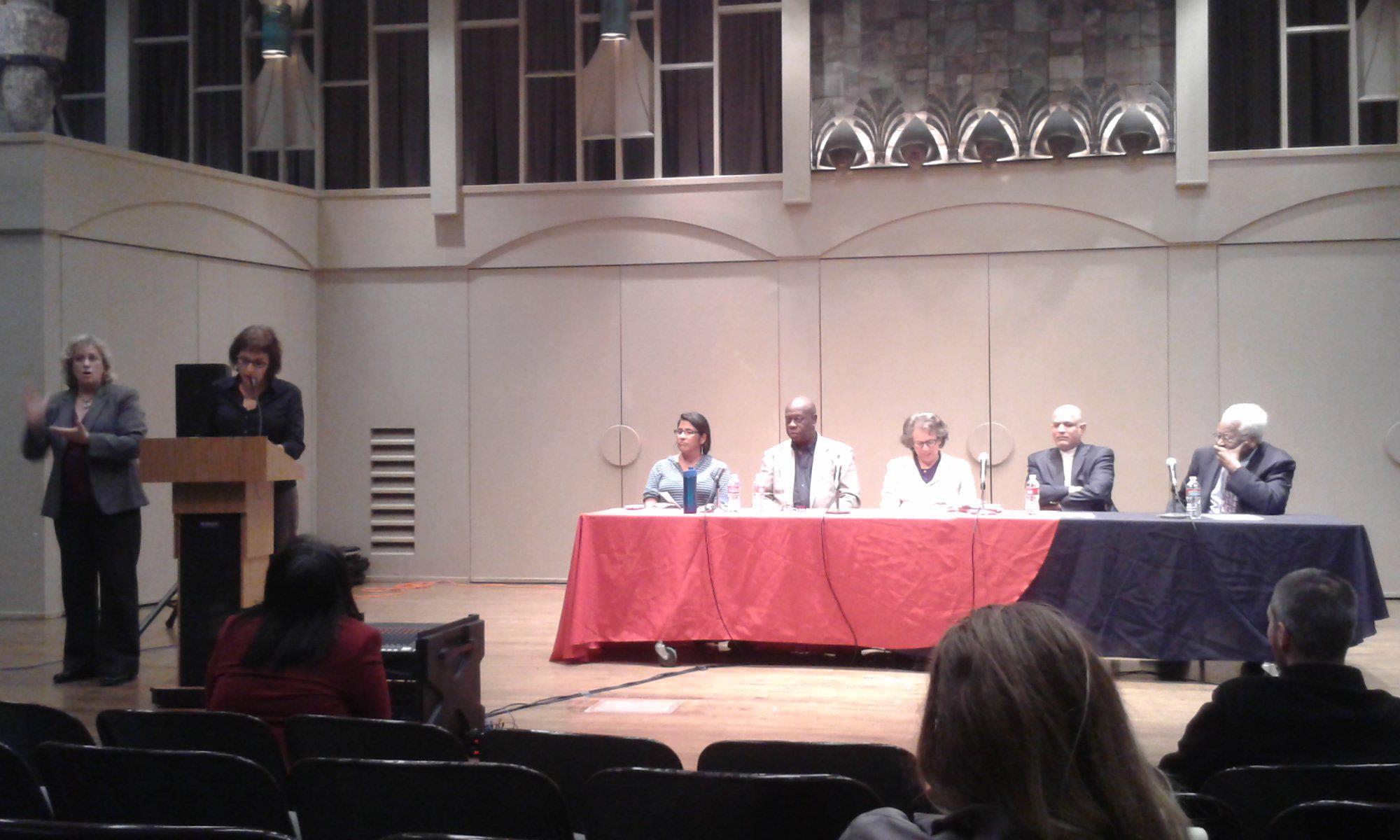
Notes from the Panel about Spiritual Activism, at California State University-Northridge, on March 18, 2013 (nearly a 10-year anniversary of the most recent US-led invasion of Iraq):

Lara Medina of the interdisciplinary Chican@ Studies Department
Maestra Olivia Chumacero of the Rarámuri Indigenous tradition
Larry Ward of the Lotus Institute for Engaged Buddhism
Rabbi Laura Geller of Temple Emmanue in lthe Reformed Jewish Tradition
Shakeel Syed of the Islamic Shura Council of Los Angeles/Orange County
Rev. Dr. James Lawson, longtime nonviolent activist

In July 2013 I led a 6 person delegation on behalf of Hope Equals to Palestine and Israel. There were heard Mohammed Al-Azzah’s story of police brutality, humiliation and injury.  He was in jail at that time, so it was his uncle who shared about it with us. Please read the coverage here in +972 a leftist Israeli online zine.

It’s also really important to know about other people’s holidays. Vaisakhi represents the founding of the Sikh community, known as the Khalsa and is celebrated on April 14 every year.  “With the distinct Khalsa identity, Guru Gobind Singh gave all Sikhs the opportunity to live lives of courage, sacrifice, and equality. These Sikhs were to dedicate their lives to the service of others and the pursuit of justice.” The panj pyare (five beloved ones) all exemplified certain qualities. These principles radiate throughout the Sikh faith. They are: kindness, justice and righteousness, organization, courage, and majesty.

Jonathan and I wrote a video series, at the request of Mennonite Mission Network, called Stir Up Peace. It’s available at here. Study guide coming in the Fall of 2021.

Secondhand sound in Seoul

Standard

Seoul Incheon airport is now at the top of my list for airports to sleep in. Seriously.

Having gone to sleep at 2am in this sophisticated, calm, open, hyper-modern mansion, I awoke at 7am with the sense that there were thousands of people around me. I sat up, pulled off my eye cover and indeed there were! 

I see people moving in every direction with this kind of hustle-waddle walk. I see managers of duty-free stores opening up for the day, and cleaning ladies on electric carts (like those that elders sometimes use to get around) laden with baskets of gloves, sprays, and other cleaning supplies. They’ve got with broom attachments on the front and the sides to sweep as they go along. 

As I sit here next to one of the ubiquitous cellphone/computer charging stations, I can hear the secondhand sound of a myriad of videos playing on iphones. I used to watch cartoons on Saturday mornings. I wonder what they’re watching.

Today is the day.My time in Korea will be jammed packed, so I don’t even mind that my initial connection in the city for a party and place to stay last night upon arrival fell through (her phone died so I couldn’t get through to her; my plane arrived four hours late anyhow). This allows me to take things really slowly.  I did, and strolled through the late-night-quiet airport to stash the 2,000 flyers I brought for the CPT Exhibit at the World Council of Churches event.

But then things got fast again when I hooked up to the “super-quick-and-completely-free” wireless internet and took a few hours to catch up on email.

It does feel odd at times to write emails in Detroit, USA, get on a plane, catapult across the sky while sleeping, eat three meals, learn some Korean vocab from my seatmate, meditate, wake up, go through Customs and Immigration, then get off the plane, hook into the internet and keep writing emails as if nothing has changed.  But such is work-life when you can have an office anywhere you can find Cloud cover.

I’ve already learned from my seatmate (while and how they were teaching me vocabulary) that there are some fierce media-generated stereotypes about African-Americans that Koreans have.  I’m not particularly happy about that…will learn more. I already learned that here is a mental pattern from their own history that coloration relates to economic class as those people who were darker were those who labored in the sun all day, workers.  I remember a Jewish genius-friend of mine in Los Angeles wrote an entire PhD thesis about images of African-Americans and Latinos held by Korean, Chinese, and Japanese exchange students at UCLA.  So there is definitely more to learn.

I wonder how this place will react to a meeting of the GLOBAL church here in the southern part of South Korea, Busan.  Hopefully we can bust all types of stereotypes. The theme of this 10th World Council of Churches meeting is “God of Life, Lead Us to Justice and Peace.” At the same time that the US mega-military and imperial economic strategy is making a “Pacific pivot,” I pray that the church’s presence here scrambles that all up, showing a very different way of what it means to share the world and its resources.

Now off to Capoeira class here with Mestre Zumbi, that always renews my s(e)oul and gets me in the correct time zone: the Present.

Carnival de Resistance

Standard

1491369_10201695172115660_1654014894_o

As a theologian and scholar-activist, I loved sharing circus theology and inviting the curious and the apathetic, the annoyed and the skeptic, into our whirling-twirling experiment of life together under the shelter of God’s big tent. I reveled for the month in the space; a space that by God’s grace and Earth’s sustenance held all manner of creatures, odd connections, swirling energies, and hard questions.  Even though we as individuals did not have the answers to many of the questions that arose from our troupe and the local audience-participants, we COULD gain collective wisdom or flashes of insight by putting them into holy PLAY and embodied conversation through the performance of old stories and the community practices of returning to ancient pathways.

The organizers had great ideas and powerful convictions. The group benefited from their expert facilitation and passion for being invitational rather than coercive. I was clear that the Carnival de Resistance in Virginia was what we later dubbed a ‘white folks recovery project’, and that clarified my expectations. I was able to bring my experience as a traveled young woman of color to bear, and the space that was created for mourning loss of indigeneity and dignity was wide enough that I could also participate in my personal process of grief and reconnection.  The organizers endeavored to make our art together on stage and off stage both clear and flexible. I felt I knew what my various tasks/rol1375060_186710431515198_1044181541_nes/foci in community life and performances were; I felt very appreciated; and I knew that I was balancing what I was doing there with the demands of simultaneous outreach work for Christian Peacemaker Teams…one of the sponsors of the Carnival de Resistance. In the hospitable and watching land of the Sinibo (Harrisonburg) an the Monacan (Charlottesville) I got to preach, perform, consult, play, laugh, learn, compost everything, re-wild, sing. This is a month I will never forget for the rest of my life.

A Long Article

Standard

Writing this was a labor of love…

In this issue of The Other Journal, we have used the lens of Marxism to illumine the consequences of economic exploitation and the ways we as Christians might work against such exploitation. Christian Peacemaker Teams (CPT) is an international nonprofit organization that aims to perform that same work, addressing racism, sexism, heterosexism, nationalism, and economic exploitation in all its forms all around the globe. CPT partners with marginalized communities in situations of lethal conflict where CPT is invited to participate, places like Hebron/Al-Khalil Palestine, Iraqi-Kurdistan, Colombia, and the First Nations in the Canadian provinces. These invitations come from the local leaders of movements for nonviolent social change. In this interview with Sarah Thompson, CPT Outreach Coordinator, discusses the origins of CPT and what it means to wrestle with imperialism in peacemaking.

The Other Journal (TOJ): How did you first get connected to CPT and what compels you to work with the organization?

Sarah Thompson (ST): I first got connected with CPT through the Peace Club at Bethany Christian High School, a Mennonite school in Goshen, Indiana. One of CPT’s project support coordinators spoke in a chapel service about the Israeli-Palestinian conflict and about the importance of joining together peacemakers from different walks of life in that region. The speaker also noted similarities between Israel’s settlement of Palestine and the settlement of the Midwest by European pioneers. He told us about the Pottawatomie, who lived on the land before our school was built and who still live and exist in the area today.

Click here to read the rest of the article: http://theotherjournal.com/2013/08/22/embodying-peace-transforming-violence-an-interview-with-sarah-thompson/